

Business design: connecting customer needs and business strategy
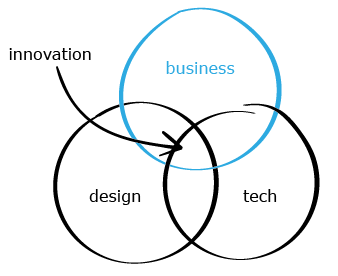
Business design brings design principles and business strategy together to develop original, sustainable solutions that meet customer needs and commercial goals.
This approach is particularly useful wherever continuous innovation is essential to survival and success. In other words, almost everywhere.

A little context
Historically, service design focused mainly on making services more desirable, helping businesses compete by meeting customers’ expectations and needs in more meaningful ways.
Over time, pioneering firms such as IDEO and Fjord began combining service design with business strategy, contributing to the development of business design. The aim was to create services that were not only appealing, but also economically viable and profitable.
Business design rests on three main principles:
- User-centred business: Every business design project starts with empathy and a thorough understanding of people’s needs and wants.
- Analytical thinking: Alongside its focus on users, business design requires rigorous analysis of existing and potential business models to establish whether proposed solutions are commercially viable.
- Interdisciplinary collaboration: Designers, business strategists, technologists and other stakeholders work together to develop solutions that are both innovative and achievable.
Getting started with a business design project
A business design project generally begins with these steps:
- Define the problem: Clarify which business problem needs to be solved and why it matters.
- Research with users: Use ethnographic research and interviews to understand people’s needs and experiences.
- Explore business models: Analyse and refine possible business models that could sustain the proposed design solution.
- Prototype and test: Build quick prototypes and test them with users, improving the ideas in response to feedback.
Putting it into practice
Business design helps organisations adapt to market changes and respond proactively to emerging challenges. By connecting user needs with business goals, companies can develop offers that meet or exceed customer expectations, supporting loyalty and growth.
Practical applications
Examples in practice
- Apple: Apple is often cited as a business design success story. Its focus extends beyond innovative products to how those products fit into a wider ecosystem of software, hardware and services, creating a coherent user experience and a strong business model.
- Airbnb: Airbnb changed the accommodation industry by understanding the needs of both hosts and travellers and creating a platform that serves both groups. It illustrates how business design can help adapt traditional services for a digital setting.

What does this look like day to day?
- Think like a designer: Treat business problems as opportunities to innovate, using design tools to explore creative solutions.
- Prototype your ideas: Build early prototypes that can be tested and adjusted quickly, without spending a fortune. This reduces risk and allows for improvements before launching the business.
- Involve owners and managers: Make sure stakeholders, including senior leadership and potential users, are involved and committed from the start.
- Measure, measure, measure: Define clear measures of success that cover both the impact on users and the return on investment.
Management and measurement methods such as objectives and key results (OKRs), alongside regular assessment of return on investment (ROI), can help organise the start of a project like this.
Using OKRs in business design
OKRs (objectives and key results) are a goal-setting method that helps organisations define clear, measurable objectives with specific outcomes to achieve within a set period. In business design, they can focus effort and resources on the areas with the greatest impact, connecting design initiatives to the company’s wider strategic goals.
Writing effective OKRs:
- Define the objective: It should be ambitious, inspiring and aligned with the company’s business vision. For example, “Improve customer satisfaction through a redesigned user experience.”
- Set key results: These are quantitative indicators of progress. For example, “Reach a customer satisfaction score of 90%” or “Reduce technical support calls by 30%.”
- Choose initiatives: These are the tasks or projects undertaken to achieve the key results. For example, “Redesign the interface of product X” or “Introduce a new customer feedback platform.”
There are also ways to develop this work through approaches focused on growth and hypothesis validation. These help companies test the viability of ideas and strategies before committing to them at scale, reducing risk and making better use of resources. Here are some useful approaches:
Lean experiments draw on Lean Startup methods, which emphasise fast, efficient innovation through repeated iterations of minimum viable products (MVPs). Small experiments test assumptions about products, services or individual features, generating evidence about market acceptance.
Design of experiments (DoE) is a statistical technique for planning, running and analysing experiments systematically. It allows several variables to be tested together to identify which have the greatest effect on the desired outcome, helping optimise products and processes.
A/B testing: A common method for comparing two versions of a product or service against predefined measures. It is widely used in digital marketing, product development and website optimisation.
Pivoting: A strategic change to an aspect of a business model, product or service, based on feedback and learning from tests and experiments. It helps companies adapt to market needs without committing substantial resources prematurely.
Customer discovery and validation: Early stages of the customer development process described by Steve Blank. They involve interviews and conversations with potential customers to identify meaningful problems and test whether the proposed solution addresses them effectively.
Usability testing: Bringing real people in to use a product under controlled conditions so the team can observe usability and the overall experience. Findings inform quick adjustments that improve the product’s usefulness and acceptance.
Scrum and agile development: An approach that helps teams build and adapt products through iterative, incremental cycles known as sprints. Customer feedback is incorporated at the end of each sprint, allowing product hypotheses to be tested continuously.
Opportunity mapping: Identifying and assessing new market opportunities by mapping unmet customer needs and potential solutions. This helps prioritise innovation hypotheses according to likely impact and feasibility.
These methods help validate hypotheses and encourage an organisational culture grounded in data and outcomes. Used thoughtfully, they can support growth by identifying and exploring market opportunities with better information.
Choose methods to fit the context
Every business faces different challenges and operates in a particular setting. Before choosing methods for innovation, growth or hypothesis validation, assess that context and the company’s specific needs. The business’s stage also matters: an early startup and an established organisation seeking new opportunities may benefit from very different approaches.
Keep the customer in view
At the heart of business design is empathy: understanding customers’ needs, frustrations and expectations in depth. Much of what I have learned comes from UX design, neuromarketing and working with clients every day at Homem Máquina as a leader and consultant. This understanding is essential to developing solutions that meet or exceed expectations. Keeping customers’ needs and aspirations in view creates a more direct path to products and services with real, tangible value.
Getting started need not be complicated
- Start with a diagnosis: Build a clear picture of the business’s challenges and opportunities, including the market, audience and main competitors.
- Choose your methods: Select tools that fit the project’s goals and the team’s capabilities. There is no need for complex data methods when simpler, more direct techniques can address the challenge.
- Iterate and stay flexible: Be prepared to adapt your approach as you learn. Business design is an iterative process that benefits from responding to market changes and customer feedback.
- Measure and adjust: Set up feedback and monitoring to assess initiatives continuously. Use that evidence to refine the approach and keep it relevant and effective.
Knowing a wide range of innovation methods is useful, but success in business design does not depend on how many tools you use. It depends on choosing and applying the right ones. The focus should remain on creating value for customers or the business and addressing people’s needs effectively and with empathy. This helps design solutions work better, strengthens the relationship between a brand and its customers, and supports sustainable results over time.
Business design is more than a method. It is a way of putting design at the centre of business strategy. It combines empathy, creativity, strategic analysis and collaboration to turn ideas into viable, lasting businesses that create value for both users and the organisation.